
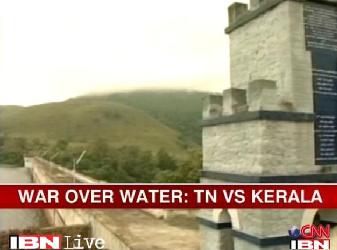
The Mullaperiyar dam issue between the south Indian states of Kerala and Tamil Nadu is now escalating to uncontrollable levels with a feasible solution out of sight.
With passions rising high on both sides of the border, mass agitations have already begun with people and business establishments of each other’s state being targeted.
The political circles at both states have reinforced their hard stands and have legalized them through legislations.The situation is highly critical and volatile, with lakhs of people who have a direct relevance with the issue, marching for a direct conflict. People and pilgrim movement, movement of essential commodities cross the borders have been affected.

The dam in contention was built by the British between 1887 and 1897 across the Periyar River. The dam and the river are in Kerala, but subsequent to a 999 year lease agreement, it is operated by Tamil Nadu.
The lease indenture dated 29 October 1886 was signed between the Maharaja of Travancore, Visakham Thirunal Rama Varma and the then British Secretary of State.
Another recent agreement in 1970 provided for Tamil Nadu to also generate electricity from the dam. The current developments stem from the fairness and current relevance of the dam and its safety. The dam has been listed as an endangered dam under the Kerala Irrigation and Water Conservation (Amendment) Act, 2006.

The dam diverts water eastward through a tunnel for the Vaigai basin around Madurai for irrigation, benefitting about 68558 ha, in Tamil Nadu. The Periyar Power Station also generates power from the diverted waters.
The initial flare for today’s conflict may be attributed to 1979 when reports appeared in the Kerala state press questioning the safety of the Mullaperiyar dam.
The reports were subsequent to the Morvi dam burst in Gujarat, which led to a massive flooding and loss of life.
On November 25, 1979, the Chairman of the Central Water Commission (CWC) held talks with the irrigation and electricity officers of both states where medium and long term measures for strengthening of the dam were taken up. Among the immediate measures taken up was to have the shutters of the spillway raised fully, so as to lower the reservoir level to 136 ft.

The Tamil Nadu government wants the dam height to be increased from its 136 ft to 142 ft. to benefit agriculture against failing crops.
The diverted waters are a lifeline for several Tamil Nadu districts like Theni, Madurai, Sivaganga and Ramnad Districts, even for drinking.
However Kerala’s stand is the safety of the 116 year old dam built with stone ruble masonry with lime mortar grouting. Kerala wants to decommission the dam and build a new one. When the matter went to the Supreme Court, the court adjourned the hearing to enable the states to settle the matter amicably.

Thus we have a situation today, of existence of one against the livelihood of the other. With tensions and vandalism on both sides, there have been no positive signs for an end in sight.
Perhaps the best understanding of the issue was reflected by the former minister and former UN under secretary Sashi Tharoor who described the developments as essentially an “human issue”.
The conflict point is among the innumerable ones either existing or developing in the contemporary world, where the survival of one section is at risk, to facilitate the sustenance of the other. The Koodankulam nuclear plant also in TN, is witnessing immense protest against being operational. The local population fears an earthquake compromising the nuclear plant safety, like what happened with the Fukushima plant. Examples of this type are endless.

Resolving the Mullaperiyar dam issue requires an in-depth understanding of human values beyond contemporary and legislative developments. The two sides require mature individuals who could acknowledge and respect each other’s concerns.
Being sustained at the cost of risk to another’s life, or depriving someone of a livelihood at the cost of personal safety are truly unethical.
The issue is associated with innate human values clouded by larger perspectives of the contemporary needs and the large number of stake holders. Whatever the outcome may be, Koodankulam and Mullaperiyar have a larger relevance to collective living and mutual welfare upon the face of earth.


