
Seldom has such an effort undertaken by man in recorded history as the attempts of the Tamil Nadu government to introduce new Tamil words equivalent to English. What the government or the Tamil language itself stands to gain from this venture is anyone’s guess. Unrealized and unseen behind this venture, there are several casualties. For instance the words computer and email is used in almost all Indian languages including Bangla and Telugu that have more speakers than Tamil. By renaming computer to kannani in Tamil, email to minanjal, and app to seyali; one wonders who has gained what. Computers and email help us communicate with people all around the globe and the terms ‘computer’ and ‘email’ are universally used. To use technology and benefit from it to the maximum, one cannot avoid these words. It is unfortunate that there seem to be a pathetic lack of the understanding of the need, use, and the sociology of the languages. These efforts of inventing words not only make the language progressively difficult but also cause huge unrealized effects on the society.
In November 2017, the Tamil Nadu minister for Tamil, art and culture, Pandiarajan had announced that the government would introduce 1000 new Tamil words each month to strengthen the language’s ability. According to the eveninger, News Today Pandiarajan said, “The state of Tamil language in the international arena is not good. For example, even Google translate is not able to get the grammar correct when it comes to our mother tongue while it does its job fluently in other languages. The main reason for this, I believe, is the lack of constructive propagation. The language continues to be hard to imbibe for new learners”. Pandiarajan has a personal track record of leading and excelling in the HR services industry, at the highest level. Sadly, how can invention and introduction of new words rather than adopting any existing word, could make any language easy. Almost all Indian languages including Hindi freely use English words. It is easy to speak, easy to understand, none is offended. Mixing of English words is not uncommon across almost all Indian languages. When our prime minister spoke to children to tackling exams in his interaction “Parriksha pe charcha”, he freely used English words in his interaction. Some of the words used by PM Modiji during this interaction are Tension, Teachers, Television, Media, Revolution, Examiner, Parents, Classroom, Page, Exam, Mummy, Tablet, South Korea, Winter Olympics, Next question, Concentration, Special, Phone, Shift, Understanding, Transplant etc.
 English language is formed largely of words acquired and assimilated from other languages. All English words have either evolved or borrowed, none invented in contemporary times. There are several Tamil words borrowed into English, few of which are Mango (மாங்காய்), Coir (கயிறு), Copra (கொப்பரை), Catamaram (கட்டுமரம்), Teak (தேக்கு), cash (காசு), Orange (ஆரஞ்சு), ginger (இஞ்சி), curry (கறி). Yet today we don’t want to call a computer as computer, an app as app, and email as email.
Our languages are bridges with people of other languages, when bridges are broken we get more isolated. When new words are endlessly introduced, Tamil language gets more complex each day. The Tamil print media religiously use these emerging terms which tend to make reading constantly difficult. Bilingual readers, who can read both English and Tamil, obviously love reading it in Tamil. But if Tamil is constantly going to be difficult, he or she may not find reading Tamil very interesting. Tamil Nadu government has undertaken a huge back-firing risk in this uncalled, unprecedented venture.
One of the biggest losers of the government sponsored venture is its own local businesses and local tech experts. On one hand businesses want to bring in technology, innovate and expand; and on the other hand are the local tech experts capable of leveraging technology and delivering beyond the expectations of these businesses. It must be emphasized here that the ability to leverage technology and break into new territories is perhaps a street level skill in the cities here, although this has declined drastically over the years. These young tech experts with strong Tamil language skills have the ability to deliver whatever the local businesses require. One of the markers of technology adoption today, also widely sought by the central government and by the prime minister is the use of applications or apps. There are so many apps for all union ministries through which public interact and transact with the government and bureaucracy. The union government has also opened a e-government app store where configurable and customizable apps are made available for the states to avoid duplication costs for the states. Unfortunately despite businesses requiring it and tech experts wanting to deliver, tech innovation in local businesses is poor. The reason primarily being the language barrier. Businesses are very cautious of the possibility of breaching the ‘Tamil only’ rule. With government not wanting even the word ‘computer’, how can they ask people to go to Google App Store, download it and install it. Also there could be other similar challenges in transacting with the app. Even from the developer side itself, use of terms like software, hardware, online, offline, Menu, troubleshoot, install, memory, upload, download, scan, antivirus, MB, GB, driver CD, hard disk, UPS, motherboard etc cannot be meaningfully replaced or used in Tamil. Local businesses would rather forgo tech innovation than run a risk against Tamil rhetoric backlash, particularly these days when protests are the order of the day.
 Sadly it is only these Tamil regional or local businesses with Tamil identity suffer. It must be noted here that the government’s translation portal www.sorkuvai.com invites English words for translation from the public. Unfortunately there is no guideline as to what can be and what won’t be translated. Right now it looks like a mad bulldozer getting across everything that comes its way. Strategic thinking had never been a part of TN’s modern history and now there are strong grounds for questioning its logical thinking.
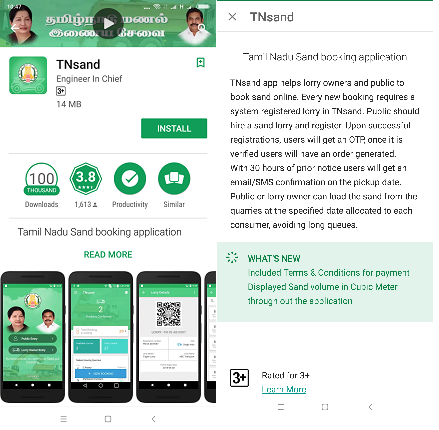
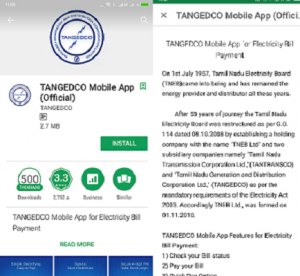
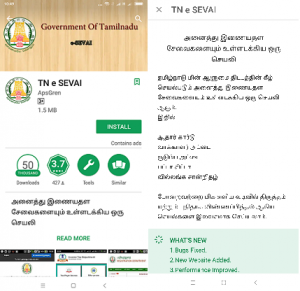
While the local businesses have failed to leverage technology, one would be very amused at how the government is going about with its own apps. The TN government has also made several apps like TN e-seva, TN MY PDS, TN Police CUG, TANGEDCO, and TNSand. Ironically unlike the central government, the state government has not been popularizing its apps and encouraging people to transact through it; this being another story. A cursory glance through some of these TN state government apps will show that the government does not consider any language barrier when it comes to its own apps. Not only are apps named in English but freely used inside too. The TN government’s idea of Tamil only does not seem to apply to its own apps.
Killing innovation in business is killing business itself. The local IT talent and the local businesses houses who fit well for each other, have been forced to sit out, when the state government and other businesses have a free unhindered ground. Forcing businesses to have name boards in Tamil have resulted in words like lodge, bakery, hotel, laundry, pharmacy, theater, etc being replaced in Tamil. Even the surname Dr. for medical physician is changed to maruthuvar. In a world where everyone is coming closer, we chose to move away. DFC appeals to the TN state government to restudy its new word formation policy against the sociology of languages and consult language specialists if the venture does any good for Tamil language. An appeal is also made to recognize all English technology terms including computer, email, and apps as Tamil equivalent words.


