
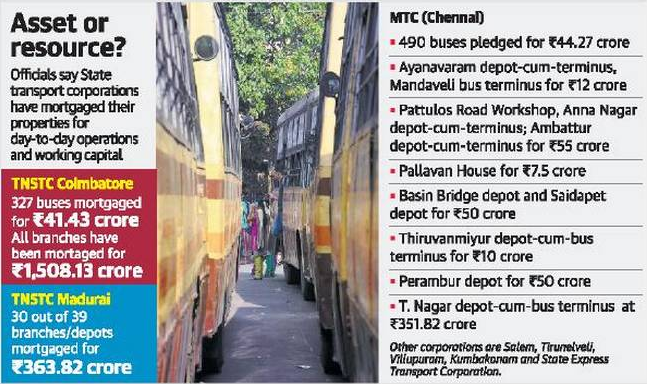
The Tamil Nadu State Transport Corporation has started a new route that no one expected or at least wanted. All the eight state-owned transport corporations in the state with most of their property including their fleet, office buildings, bus depots, besides retirement benefit funds of all employees has been mortgaged in banks for about Rs 15,000 crore.
The total accumulated losses for the Corporation at the end of 2015-16 stood at Rs 16,145 crore, which is 19% percent more than that in previous year. The eight transport corporations made 11% more losses than previous year, a report of the Comptroller and Auditor General (CAG) shows. CAG data also show that to counter falling incomes, MTC spent Rs 86 crore lesser on fuel (diesel), Rs 1.6 crore lesser on tyres and Rs 1 crore lesser on spare parts. However, its wage bill went up by Rs 270 crore.
The amount of losses is considered to be huge since the debt is more than seven times the transport budget of 2192 crores. The property under mortgage include the state express transport headquarters in Chennai, Pallavan Illamm the headquarters of city transport corporation, zonal headquarters and district headquarters. This also includes retirement benefits of employees like pension, provident fund and gratuity, say unions who claim this has been condition for the last 15 years.
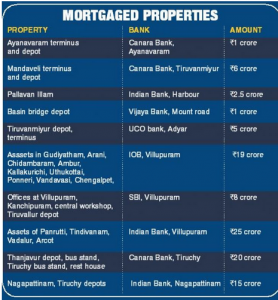
The state express transport corporation headquarters in Chennai, its depot and its admin block, besides Coimbatore depot and bus stand have been mortgaged with Tamil Nadu Transport Development Finance Corporation for Rs 192 crore. The bus depot and terminus at T. Nagar had been mortgaged with the same corporation for over Rs 87 crore.
Patullas workshop, the depots at Anna Nagar, Ambattur have been mortgaged with IOB, Tiruvanmiyur depot with UCO bank and the depot and terminus at Mandaveli with Canara Bank. The zonal office at Kancheepuram, Villupuram, central workshop and Tiruvallur depot too have been mortgaged.
 Meanwhile details have been revealed that three of the eight Tamil Nadu State Transport Corporations (TNSTC) — Coimbatore, Madurai and Metropolitan Transport Corporation (Chennai) — have accumulated liabilities to the tune of Rs. 2,452.58 crore by way of having mortgaged not just their buses, but also land and buildings including depots. This information was revealed by replies given by TNSTC authorities to a petition under Right to Information Act filed by Madurai-based RTI activist and founder of Makkal Vizhippunarvu Arakkatallai, K. Hakkim (36). While MTC, TNSTC-Madurai and TNSTC-Coimbatore have given replies, TNSTC-Salem has refused to divulge the information.
According to The Hindu, a senior MTC official said the properties were pledged for cash requirements for day-to-day operations. “Not just property, but employee funds like provident fund, insurance and retirement benefits have been ploughed into the transport corporations to run the show,” said another transport corporation officer who deals with finances.
The Deccan Chronicle sums up the situation as: The present condition of the transport corporations is hampering them from buying new buses and improving the quality of their fleet. The employees are severely affected since their retirement benefits and future are at stake. People and workers are expecting the government to take adequate measures to bring back the corporations to a healthy state.
With the TN government moving from loans to mortgages, the functioning of the state public transport corporations need an urgent look. Nearly 520 buses owned by state transport corporations (STCs) are lying idle at different locations, as they have all been impounded by courts for having failed to pay compensation to road accident victims. This has resulted in an operational loss of Rs 4 lakh a day for the corporations.
In the past six years since 2010, more than 40,000 road accidents involving state-owned buses were reported in TN, killing a total of 9,971people. None of the 22,000 odd buses owned by STUs (except AC buses) have insurance policy to cover third party risks, said accident cases specialist and advocate V S Suresh, to Times of India. Arumuga Nainar, general secretary, Transport Employees Federation affiliated to CITU, said that the life of a bus is six years or a running distance of seven lakh kilometers. But, in Tamil Nadu 70 per cent of the buses had crossed the limit.
Last month, 8 employees of the Tamilnadu State Transport Corporation (TNSTC) died when the bus stand in Nagapattinam collapsed. According to India Today, State Transport Minister MR Vijayabhaskar said that the building was constructed in 1954. In September this year, five persons were killed and more than 10 injured when the roof of another bus stand at Somanur in Coimbatore rural collapsed,
Transport unions and government had been at talks for several months with the unions even undertaking a strike in May, this year. Trade unions including Opposition Dravida Munnetra Kazhagam’s (DMK) Labour Progressive Federation (LPF) and Left Front’s Centre of Indian Trade Unions (CITU) were demanding that the state government release around Rs 7,000 crore in the form of provident fund (PF), employee state insurance (ESI) and employees provident fund (EPF). According to the workers, they have not been paid their due for almost 4 years despite the due amount constantly being deducted from their salary. The state had told the High Court that it would settle the 1136 crore due to retired TNSTC staff.
The pathetic state of affairs at the state transport department has begun to impact the public services. The conditions of the buses and the experience of the commuters are stepping to lower levels each day. For instance the TNSTC (Nagercoil region) is operating about 820 moffusil and town buses from 12 depots. At least 50 per cent of the buses were badly damaged or in a condemned stage. Roof of most of the buses was leaking. . Recently, the roof of a moving town bus was ripped off near Putheri due to heavy wind, said students of DVD Higher Secondary School. Most of the town buses being operated in the region were condemned by other TNSTC divisions, said Mr. Thomas, president of Kanyakumari Zilla Consumer Protection Centre. Seats and windows of most of the buses were badly damaged.
Vote bank politics is taking the state to new lows. Does the Tamil Nadu government have any plans to redeem the properties? Can the government redeem it without new financing? It is unfortunate that the government did not consider it necessary to take the people of the state into confidence when it decided to mortgage the department properties. The government however is now obliged to let the people know of its future plans. The people of the state would rather shell out a few rupees more for a bus ticket whenever they travel rather than face higher or newer taxes. Policy makers should realize that at the end of the day the sad consequences of appeasement policies finally end at the doorstep of the very people they wanted to appease. Accountability needs to be fixed for this mammoth debacle that affects the people of the state.


