
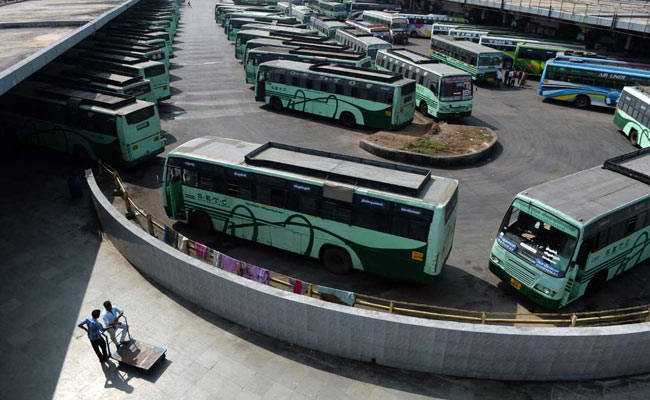
The crisis in the Tamil Nadu State Transport Corporation (TNSTC) is far from over despite the partial roll-back of fares. Unlike the fare raise of 2011, this increase is seeing uncompromising protests from public, because people now see the loss as a result of large scale, unabated corruption. With the protestors unwilling to compromise, the government has to cautiously chalk its path from here. Protestors call for a complete roll-back and although the government has partially reduced the hike , the truth remains that even if the government was allowed to implement its original hike, the situation cannot be improved, significantly. TN opposition parties too must take a well considered, positive, and purpose oriented position rather than a blunt stand. Is there anything in the world available at 2011 prices?
With mortgaged properties accruing huge interests, pending employee payments, and rise in salaries, these will easily absorb the fare hike without any significant relief. The need of the hour is a long term vision for the public transport, how and when the government can redeem the mortgaged properties; when it will complete all due payments to employees. The public transport sector in most states is on a loss, nonetheless there are plenty of opportunities to bring this loss to a very minimum and dedicated effort can bring profits too. Although a big challenge, it is not impossible to bring a turnaround for the public transport.
The opposition and government must recognize the fact that at this moment bus fare is a less important topic. The challenges ahead and how the government would tackle them is the key. Where does the government see the public transport system to be in May 2021?, when its term ends. Accountability starts now. The opposition must seek a white paper on the state of the finances of the state and that of the Tamil Nadu State Transport Corporation.
So what options does the state government have to put the buses running profitably on the roads? The situation of TN public transport is unprecedented in Indian history in terms of service scale, infra scale, and costs involved. The government must therefore look for unprecedented measures and reforms to get the transport system up and running. The path for the public transport in the state should be cautiously and meticulously planned to bring about a turnaround. The following are some suggestions which the government could look into to raise its much needed revenues. However to achieve turnaround TN government must acknowledge corruption and misappropriation as being the reason behind this debacle and seek public support for a change. The government must also make an informed decision if it can bring about a turnaround by its own without center’s support.
Fuels are a major cost factor for any transport system. The government had all through the years never considered switching to alternate fuel at least from the environment point. The government must stop buying diesel vehicles in future and fast track switching to an alternate fuel. The government should consider sending a high-level team to Delhi, meet the union transport officials and get an expert opinion on diesel alternatives including electricity, CNG, or methane mix. It must be noted here that union minister for transport Shri. Nitin Gadkari himself is an advocate of alternate fuel. TN government must seek support to step-up alternate fuel, hand-in-hand with diesel step-down. Savings in fuel can be enormous. Looking for a turnaround is important and to achieve this no stone should be left unturned. There is no doubt that the SETC debacle that occurred across decades which make the people pay today, has several hidden beneficiaries. The government could explore this option of identifying and retrieving its rightful share. The help of central government can also be sought in this regard.
Decades of misgovernance and political influence has caused a lethargic attitude and lack of accountability at any level in the public transport department. The situation today is a nightmare for the state that is already in neck deep debts and the public expecting more freebies. Putting the buses back on track is a Herculean task, but like the proverb who will bell the cat?; is there anyone willing on whose shoulder this burden will go. The government and its public transport system have a long way to go. The path to reforming the department should be embedded into the minds of each employee and their participation sought. Primarily the government requires taking several innovative and harsh steps to climb up from its pathetic state at which it is currently in.
The government could consider splitting SETC into three of four divisions for better efficiency and comparative analysis, each with determined directors for operations, purchase and accounting. Much loss can be thwarted by planning and scheduling services in synergy with other buses or trains, with costs in mind. It is important for all metropolitan services to establish a timetable and ensure that the buses leave the depot to the scheduled destination at the indicated time. These are fundamentals, yet none will agree that this is already in place and followed. One can frequently see three or more similar services from the same source leaving to same destination as a convoy.
Cut down spares bill while emphasizing on increased quality. All purchases by SETC should be transparent, make purchases only from manufacturers at negotiated prices and keep the purchases system dynamic, always open to new suppliers. Luggage is an important revenue source which should not be at the mercy of the conductors. It is probable that SETC has never achieved even 50% of transported luggage costs. Managing luggage require serious foolproof consideration. Luggage tickets could only be issued and loaded at depots.
The government should be open to newer revenue-oriented ventures. Advertisements on buses and depots can bring considerable revenues when effectively managed. Older buses can be adapted for an ancillary courier or parcel service, whose feasibility could be well studied by experts. The ancillary could be fully run by government if possible as it has all man and infra necessary for this. Pick up and drop facility could also be considered through tie ups with efficient and serious cab operators as partners, with greater integrated pricing and services. The government stand should be a willingness to participate with an eye on maximum revenue share, together with a willingness to accommodate the requirements of its associates. All these should only be initiated and led by enthusiastic and appropriate people.
Free travels cause a considerable loss to SETC and metropolitan services. Free travel by people by only trading a salute is a culture that the state transport corporations need to get away from. Free travel for personal reasons with or without uniforms and by former SETC employees need to be curtailed. The railways implement this strictly. Travel vouchers could be provided to all departments including police and secretariat for their internal travel in buses, and none allowed to travel free. This can also help in assessing the use of transport by other government departments.
The government should recognize the potential of bus bays and pursue their development as a source of big revenues. Bays on popular routes like Chennai, Coimbatore, Trichy can be developed with a variety of restaurant, motels run by tourism department TTDC. The government could also explore the option of developing bus bays with private participation, who can bring in splendid concepts for much needed turnaround revenues. Organizations like Khadi Kraft, Co-Optex, Aavin could all find a place here apart from private shops. Shopping malls with mini theaters could help. Permitting private operators to use these bus bays could also be considered. A ‘better than rail’ experience should be targeted and bus travel projected more as an experience than a necessity.
Together let us make our buses move again healthy, wealthy, and wise.


