

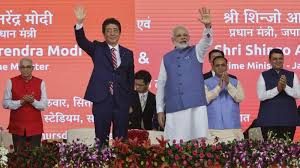
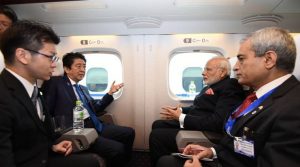
On the 14th September Prime Minister Modi and Japanese Prime Minister Shinzo Abe inaugurated the bullet train project in India. The prime minister pointed out to the nation that high speed travel is necessary for development and growth. The project costs over a lakh crore rupees and Japan shall fund over 85% of the project. With the bullet train to run between Mumbai and Ahmadabad in five years, we present a small introduction to Shinkansen technology.
Introduction
 Japan was one of the earliest countries that anticipated long distance travel needs of its people and the inability of its road transport system to meet the same. With its densely populated cities increasingly requiring more travel and shorter travel time, the Japanese government decided in developing high speed rail. With the Japanese Parliament approving the proposal in 1958, the high speed rail system; the bullet train or the Shinkansen, was ready in five and a half years, in time for the 1964 Tokyo Olympics (Raynor, “Japan Bullet Train”). The success of the Japanese Shinkansen, inspired countries including many European countries to develop high speed trains (Keating, “The Shinkansen”). . The term “bullet train” is common outside Japan but in Japan, visitors would only see Shinkansen on English signs (Japanese Lifestyle, ”Shinkansen History”).
History of the Bullet Train
 Japan is perhaps the first country to have an exclusive railway line for its high speed trains. Its earlier rail network had a 3 ft 6 in gauge, which couldn’t be adapted to high speed requirements. Also the existing gauge lines were round about, increasing the travel distance. The Shinkansen lines are standard lines, passing through tunnels and ducts. The first Shinkansen train which ran between Tokyo and Osaka had a speed of 210 km/h or 131m/h. The Osaka-Tokyo rail track cost $640 million, but soon began operating on profit within eighteen months of operation (Raynor, “Japan Bullet Train”). The Shinkansen line was originally intended to carry passengers and freight, day and night, but was then restricted to passenger trains alone. These trains ran initially between Tokyo-Osaka, which now run all over the mainland Honshu, on newly laid Shinkansen. lines.
The Tokaido line built between Tokyo and Shin-Osaka in 1964, covered a distance of 515 km. In 1972, the Sanyo line between Shin-Osaka and Okayama was started which was then extended in 1975 up to Hakata (Keating, “The Shinkansen”). This was followed by the inauguration of two lines in 1982, namely the Tohoku line and the Joetsu line from Omiya to Morioka and Niigata respectively. The Tokyo to Nagano, Hokuriku line was opened in 1997. Much technical advancements have led to the development of newer models of the trains. The models of trains are also associated with the lines they operate. For instance the series 300 trains operate on the Tokaido line at a high speed of 270km/h while the series 500 trains operate on the Sanyo line at a maximum sped of 300km/h (Keating, “The Shinkansen”).
Highlights
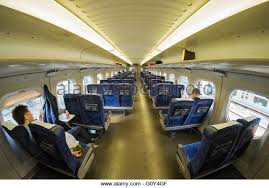 The Shinkansen can cover the 192 kilometer stretch from Hiroshima to Kokura in 44 minutes. The Shinkansen network not only have trains capable of reaching about 300km/h but also have trains running very frequently (Japan Railways Group, “Shinkansen”). For instance there are about six trains per hour running between Tokyo and Shin-Osaka, during the day. Shinkansen also has a good record at maintaining its running schedules. In its 2003 report, the JR Central revealed that the average arrival time of the bullet train was 0.1 minutes or 6 seconds within its estimated time of arrival. This estimated time is inclusive of all natural and human accidents and is based on its total of 160,000 trips. There is a maintenance shutdown between midnight and 6 am, during which time, the trains run on the parallel narrow gauge lines (Japanese Lifestyle, “Shinkansen History”).
There are sixteen cars in the Shinkansen train, each having a length of about 25 m. The longest train measures 400 meters from end to end with the stations being appropriately lengthy to accommodate them. The railway system also has an incredible safety record. In over forty years of its operations, it has carried over six billion passengers and has not had any serious accident. It was only in October 23, 2004, that it experienced its first derailment, due to the Chuetsu earthquake (Japanese Lifestyle, “Shinkansen History”). Eight of the ten rail cars of Toki No. 325 got derailed near the Nagaoka Station in Niigata. Though there were 154 passengers on the train, there were no fatalities (Japanese Lifestyle “Shinkansen History”).
The development of Shinkansen series
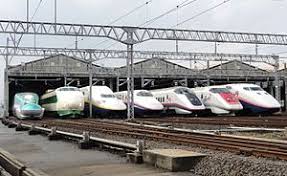 The tracks for the Shinkansen are very different from the earlier ones. The super-express track will have shorter spaces between the rails. It would also utilize a new power gauge. The new track will likewise cover a total of 1,954 kilometers (Raynor, “Japan Bullet Train”). The Shinkansen 0 series remain fresh in the minds of most non-Japanese because of the publicity and awareness it raised world wide when it was introduced for the first time. It wasn’t classified as 0 series then as it was the first high speed rail (Japanese Lifestyle, “Shinkansen History”). The nose of the train was said to have been designed corresponding to the Douglas DC-8 airline. The axles of all 0 series car were powered by 185 kW traction motors to correspond to a speed of 220km/h. The production of 0 series continued till 1986. The Shinkansen 100 series was produced between 1984 and 1991 and had a more pointed nose. Here the driving cars at the ends and the center cars are not powered, although later productions had powered driving cars. This series have been systematically replacing the 0 series in the slower service sectors using 4 and 6 cars (Japanese Lifestyle, “Shinkansen History”). The Shinkansen 300 series were introduced in 1992 and was capable of reaching speeds of up to 270km/h. These trains had a curved wedge shaped nose. Two refreshment counters were earlier planned for the 300 series which were later withdrawn. These were the first Shinkansen series to employ 3-phase traction motors.
The 500 series of the Shinkansen are the most powerful and expensive of all. Capable of running at a maximum speed of 320km/h, they currently operate at a maximum of 300km/h. The 500 series bullet train has a length of 82 feet and a width of 11 feet, which is huge enough to accommodate a large number of passengers. Its 12-foot ceiling gives the tallest passengers plenty of room to operate (Raynor, “Japan Bullet Train”). The 500 series Shinkansen train is composed of sixteen cars and can accommodate a total of 1,324 passengers, which can be divided into 200 first class and 1,120 second class accommodations. These trains have a 15m long, pointed needle like nose similar to that of a supersonic plane. A dome like canopy for the driver facilitates view of the rail track. The running gear uses a computer assisted active suspension which provides a smoother ride. Only nine of these series have been built as the price tag for each is about $40 million. They entered service between 1995 and 1998 on important sectors. The 500 series also incorporates a specially designed pantograph which lowers wind resistance even at high speeds (SPG Media, “Shinkansen High Speed Bullet Train”). Its aluminum honeycomb panels minimize the sound from the tires on the tracks as well as other external noises produced by the train (Raynor, “Japan Bullet Train”).
The 700 series introduced in 1999 were built between 1997 and 2004, with an aim of developing a fast train like that of series 500 but at a lower cost. The 700 series are aerodynamically designed with a duck bill type nose. Capable of reaching a maximum speed of 285km/h, the traveling time is a little over that of the 500 series.
Conclusion
The Shinkansen has contributed to the development of the country in its own way. It has helped to reduce the number of cars in the already densely populated cities. The ability to transport more people at a shorter time and more comfortably has helped the Japanese people. People could travel without reservations at reasonable charges. A distance of 100km was soon a commuting distance, and Shinkansen was preferred to plane travel on several routes. The national census of 1990 and 1995 revealed that the number of people commuting between Gunma and Tokyo increased by 35% in these five years and that of people traveling between Maebashi and Ohmiya rose by 72% (Kung Ja, Kuem, “The Impact of Shinkansen Construction on Regional Development”) With the introduction of the Shinkansen, long distance commuting became a common feature, facilitating exchange of people, culture and products. Shinkansen was also instrumental for the development of high speed trains in other parts of the world including Europe.


