
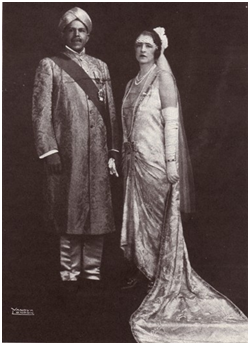
During the rule of princely states in India, many princes sought European women. Some sought them for teaching while some for pleasure. However there were princes who fell in love and sought their hand. The rajah of Pudukkottai is one such prince who stood by his Australian love, even if that love meant his fall.
The first Portuguese women entered India around 1510, settling in picturesque Goa to become the brides of lonely Portuguese officials living a solitary life in majestic palaces. This was followed by the East India Company bringing in women from Britain for the English merchant who until then was taken care of by lowly Indian women.
Soon women of all social class found their way into India, given the need for various roles. While there were teachers coming to teach members of the European families, there were also women missionaries sent by the welfare groups who worked for the upliftment of women from child marriage, female infanticide, polygamy and purdah.
The lavish lifestyles of Indian princes during the pre independence era are well known. Most princes had a desire for European women. Women from Britain and Europe were offered expense paid trips to India by the princes, were they lived in luxury. There were princes who actually fell in love with these European women, married and made them their maharani.
However the British were against such marriages, which they felt, lowered the white man’s image. They increasingly targeted such princes even withholding official recognition. In her book, Wicked women of the Raj, Coralie Younger recounts the experiences of several such princes. One among them is Martanda Bhairava Tondaiman, the Rajah of Pudukkottai. Incidentally, Coralie Younger is also the co-author of the biography of Molly Fink, the lady who married the rajah of Pudukkottai.
Martanda Bhairava was the third son of the eldest daughter of Rajah Ramachandra Tondaiman. With no male heir, the Rajah adopted his grandson Martanda to the throne in 1894. Pudukkottai was a small state with an area of twelve hundred square miles. Martanda led a lavish lifestyle, employing about 924 employees at his Trichirapally palace. He was also building a new palace at Pudukkottai. Martanda had several affairs with white women and was in fact warned by the British authorities against entering into an alliance with a European woman.
In March 1915, when Martanda was on a trip to Australia, he met Molly Fink in the restaurant of a hotel. Molly was with her mother Elizabeth and sister Ida. Martanda changed his travel plans and joined them. He even put his car and chauffeur for Fink’s use. After knowing each other for five months, they finally married at a registrar office in Melbourne. Lord Pentland, the Governor of Madras showed his displeasure. King George V also showed his opposition in a letter addressed to Viceroy Lord Hardinge. Molly was however greeted with full honors by the people at the palace and the rajah expected British approval soon.
Martanda was then told by the British authorities that only he would be invited at social functions of the Governor, thus refusing to acknowledge Molly as a rajah’s wife. To this Martanda replied that he would prefer not being invited. Martanda took Molly who was by then pregnant, to Australia and lived in a rented haborside mansion. He refused to come to India until Molly was given the due titles and honors of a rani. On 22nd July 1916, their son Martanda Sydney Tondaiman was born. In 1920, the British authorities informed Martanda that his son would not be granted recognition.
Disheartened, Martanda settled for a deal to remain the rajah of Pudukkottai only in name. For this he agreed to receive a huge lump sum plus annual allowance. In 1927 when in Paris, Martanda suffered intestinal pain and underwent two operations. However his conditions worsened and he died with his wife and son beside him. The authorities at Britain refused to fly his body to Pudukkottai where he would have a cremation worthy of a ruler. The authorities were afraid that if the body was cremated in Pudukkottai, there would be a sympathy for Molly and her son, prompting the young son’s right to rule. Martanda was ultimately cremated at the Golders Green crematorium in London according to Hindu rites.
On 20th November 1967, Molly died of bowel cancer. Martanda Sydney took to criminal activities and had to spent time in Sing Sing prison. The FBI and the British kept a close eye on him. Martanda Sydney was used as an example by the British authorities to dissuade Indian princess marrying Europeans. They emphasized that the offspring of two different races would have the worst qualities of both. In January 1984, Martanda Sydney died of heart failure, bringing an end to a royal family lineage. Coralie Younger notes that the rajah’s family in Pudukkottai contested the will of Martanda and successfully won a large part of his estates and property. They are still investigating possible locked assets in Swiss and US banks.
Maybe they would learn and succeed in getting more of the Pudukkottai rajah’s assets. But what they would probably not seek to understand was why a raja, rani and a prince were never accorded their rightful place; just because a black raja loved a white rani.


